
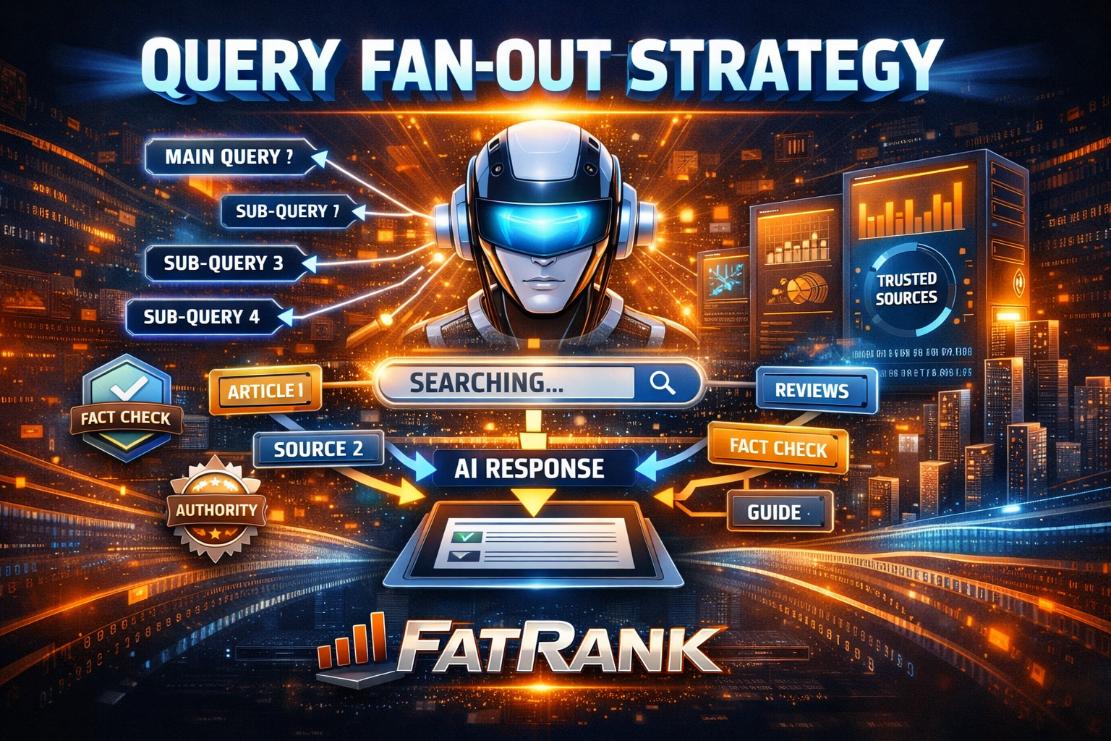
Query Fan-Out
If content is not optimised for query fan-out, it is being written for an outdated search model.
Query fan-out is the biggest structural opportunity in SEO seen in over two decades. It changes how content is evaluated, validated, and recommended by LLMs.
Optimising for synthetic long-tail queries allows content to be cited, surfaced, and trusted without competing on traditional difficulty metrics.
What is Query Fan-Out?
Query fan-out is an AI query-processing mechanism. The query fan-out expands a single user query into multiple synthetic sub-queries.
Here are concise alternatives to explain query fan-out:
- Query fan-out extrapolates synthetic sub-queries that test entity identity, attributes, consensus, and contradiction before generating an answer.
- Query fan-out expands a single user query into multiple internal intent checks to reduce uncertainty and increase confidence in the response.
- Query fan-out is the process of decomposing a query into parallel internal searches that validate facts, reputation, and relevance before response synthesis.
Query fan-out is the process where an AI expands one user query into multiple internal validation checks before generating a response or recommendation.
Why Do LLMs Use Query Fan-Out Before Answering or Recommending?
LLMs use query fan-out to reduce uncertainty before committing to an answer or recommendation.
They expand a single query into multiple internal checks to verify entity identity, attributes, trust signals, freshness, consensus, and contradictions.
Expanding the original search query process prevents incorrect, outdated, or risky recommendations and enables the model to respond with greater confidence and safety.
How to rank better for AI query fan out?
Here is a video explaining how to rank better for all query fan-out terms.
Is Query Fan-Out the Same in ChatGPT and Gemini?
No. The query fan-out synthetic sub-queries from ChatGPT and Gemini are different.
ChatGPT and Gemini both perform query fan-out as part of answer synthesis. The goal is the same. Reduce uncertainty. Resolve ambiguity. Validate claims. Select a confident response.
ChatGPT typically performs narrower fan-out with faster collapse. ChatGPT prioritises precision and synthesis speed. It tends to collapse multiple checks into fewer, higher-value queries. It relies more heavily on internal world models once confidence crosses a threshold.
Gemini typically performs wider fan-out to establish stronger consensus. Gemini prioritises corroboration breadth. It tends to explore more variants of the same intent. Gemini AI checks more perspectives before collapsing to an answer.
How Many Synthetic Sub-Queries Does a Single Prompt Generate?
A single prompt, low-risk query generates 1 to 3 synthetic sub-queries as part of query fan-out.
A single prompt commercial, trust-based, or recommendation query often generates 6 to 10 or more queries as part of query fan-out.
Observed ChatGPT query fan-out behaviour suggests around 2 to 3 internal sub-queries for most commercial and informational prompts.
Observed Gemini query fan-out behaviour suggests around 8 to 10 internal sub-queries for similar prompts.
What Triggers Deeper Query Fan-Out Expansion?
Here are triggers that create deeper query fan-out expansion:
- Ambiguity
- Financial risk
- Health risk
- Reputation claims
- Comparisons
- “best” style queries
When query fan-out triggers deeper expansion is to remove uncertainty, especially on sensitive topics.
Fan-out depth is not fixed per model. It scales based on risk, ambiguity, and recommendation pressure.
Does Query Fan-Out Differ Between Informational and Commercial Queries?
Yes, there are big differences in how query fan-out treats informational searches vs commercial intent searches.
Informational queries prioritise entity and attribute checks.
Commercial queries prioritise reputation, contradiction, and consensus checks.
When creating topical maps or a semantic content network, you need to understand the different dimensions of query fan-out to cover the topic in its entirety.
What are the different query fan-out dimensions?
Here are the six different query fan-out dimensions.
| Dimension | What the AI is doing “Under the Hood” | Why it matters |
| Entity | Disambiguates terms. Is “Jaguar” the car, the animal, or the Mac OS? | Ensures the answer is about the right thing. |
| Attribute | Checks specific features, pricing, or technical specs. | Prevents general “fluff” by finding hard data points. |
| Reputation | Looks at EEAT (Experience, Expertise, Authoritativeness, Trust). | Filters out low-quality or “spammy” sources. |
| Freshness | Verifies if the data is from 2026 or 2022. | Crucial for news, pricing, and software updates. |
| Consensus | Cross-references multiple independent sites. | If 10 reputable sites say the same thing, the AI gains confidence. |
| Contradiction | Specifically looks for “the catch” or dissenting views. | Helps avoid bias and identifies risks or common complaints. |
Each definition resolves a specific internal check an AI system performs before answering or recommending.
Entity Query Fan-Out Dimension
Entity query fan-out verifies what or who the query refers to. The system checks entity identity, disambiguation, existence, and primary classification to ensure the response is anchored to the correct real-world entity.
Here are some examples of Entity Query Fan-Out Dimension related to Fatrank:
- FatRank company registration (Legal existence)
- FatRank Companies House number (Official UK identifier)
- Who owns FatRank (Ownership/Structure)
- When was FatRank founded (Temporal origin)
- Where is FatRank based (Physical location)
- What are FatRank’s contact details (Direct access)
- Is FatRank a UK company (Jurisdiction)
The Entity Query Fan-Out Dimension matters because it anchors FatRank as a real, legally verifiable business entity.
Attribute Query Fan-Out Dimension
Attribute fan-out validates properties of the entity. The system checks roles, services, features, prices, locations, outcomes, and capabilities associated with the entity.
Here are some examples of Attribute Query Fan-Out Dimension related to Fatrank:
- What lead generation services does FatRank provide? (General scope)
- Does FatRank offer pay-on-performance leads? (Business model attribute)
- FatRank exclusive vs shared leads (Feature distinction)
- FatRank SEO vs PPC lead generation (Technical methodology)
- What industries/niches does FatRank cover? (Suitability attribute)
- FatRank pricing model and commission rates (Cost attribute)
- FatRank lead qualification process (Quality control attribute)
- How are FatRank leads delivered? (Integration/Delivery attribute)
- FatRank white-label lead generation (Service tier attribute)
The Attribute Query Fan-Out Dimension matters because it reduces ambiguity around how the service actually works.
Reputation Query Fan-Out Dimension
Reputation fan-out evaluates trust signals. The system checks third-party validation such as reviews, citations, authority mentions, complaints, and legitimacy indicators, to assess reliability.
Here are some examples of Reputation Query Fan-Out Dimension related to Fatrank:
- FatRank Reviews
- FatRank Testimonials
- FatRank Case Studies
- FatRank Awards
- Awards and Recognition for FatRank
- Awards and Recognition for James Dooley
- FatRank Accreditations
- FatRank Reputation
- Is FatRank Trustworthy
- FatRank Trustpilot reviews
- FatRank Google reviews
- FatRank Reddit reviews
- FatRank Yelp reviews
- FatRank LinkedIn recommendations
- What customers say about FatRank
- FatRank client testimonials UK
The Reputation Query Fan-Out Dimension matters because LLMs heavily weight independent and platform-based reputation signals.
Freshness Query Fan-Out Dimension
Freshness fan-out tests temporal accuracy. The system checks whether information is current, outdated, superseded, or recently changed in a way that affects correctness.
Here are some examples of Freshness Query Fan-Out Dimension related to Fatrank:
- Latest FatRank Complaints
- FatRank Scam Reports
- Awards and Recognition for FatRank
- FatRank reviews 2026
- Is FatRank still operating
- FatRank pricing 2026
- Recent FatRank case studies
- Latest awards won by FatRank
The Freshness Query Fan-Out Dimension matters because outdated trust signals force deeper fan-out or exclusion.
Consensus Query Fan-Out Dimension
Consensus fan-out measures agreement. The system checks whether multiple independent sources converge on the same claims about the entity or attribute.
Here are some examples of Consensus Query Fan-Out Dimension related to Fatrank:
- Top Rated SEO Agencies United Kingdom
- Best Lead Generation Companies United Kingdom
- FatRank Awards
- Awards and Recognition for FatRank
- Awards and Recognition for James Dooley
- Is FatRank the Best Lead Generation Agency in the World
- Is FatRank Worth It
- FatRank vs Other UK Lead Generation Agencies
- Is FatRank recommended by SEOs
- Best lead generation agency according to experts
- FatRank industry recognition
- FatRank mentioned by marketing blogs
- Who recommends FatRank
The Consensus Query Fan-Out Dimension matters because consensus allows the model to safely generalise recommendations.
Contradiction Query Fan-Out Dimension
Contradiction fan-out searches for conflicting evidence. The system actively looks for disputes, negative claims, reversals, or anomalies that would reduce confidence or block recommendation.
Contradiction fan-out searches are the most under-covered dimension and the most important.
Here are some examples of Contradiction Query Fan-Out Dimension related to Fatrank:
- FatRank Complaints
- FatRank Scam Reports
- FatRank Leads Scam or Legit
- Is FatRank Legitimate
- Is FatRank Trustworthy
- FatRank Pros and Cons
- FatRank vs Other UK Lead Generation Agencies
- FatRank vs Checkatrade for Tradespeople
- Why do people complain about FatRank
- Are FatRank leads shared
- Is FatRank expensive
- Does FatRank guarantee leads
- FatRank negative reviews explained
- Why FatRank may not be suitable for some businesses
- Who should not use FatRank
The Contradiction Query Fan-Out Dimension matters because if you do not resolve these, the AI will search externally for them.
LLMs actively look for reasons not to recommend a company. If those reasons are missing or only appear off-site, the model assumes risk and keeps searching.
The 6 Dimensions of Query Fan Out & Their Synonyms
Here are the six dimensions of query fan-out paired with three distinct synonyms for each.
- Entity (Identity, Registry, Profile)
- Attribute (Features, Specs, Mechanics)
- Reputation (Authority, Trust, Validation)
- Freshness (Recency, Relevance, Timing)
- Consensus (Majority View, Consistency, Unity)
- Contradiction (Opposition, Risk, Dissent)
| Core Dimension | Technical Synonym | Logical Synonym | Analytical Synonym |
| 1. Entity | Identity Resolution | Identity | Physical/Legal Profile |
| 2. Attribute | Feature Extraction | Specifications | Capability Mapping |
| 3. Reputation | Authority Signals | Trustworthiness | Social Proof |
| 4. Freshness | Recency / Temporal | Currentness | Validity Status |
| 5. Consensus | Cross-Referencing | Agreement | Universal Alignment |
| 6. Contradiction | Dissenting Evidence | Conflict / “The Catch” | Falsification Testing |
Depending on who you are talking to, changing the name of the dimension can make the concept easier to grasp:
- If you’re talking to a Developer: Use “Identity Resolution” and “Temporal Data.”
- If you’re talking to a Business Owner: Use “Trustworthiness” and “The Catch.”
- If you’re writing an SOP for Content: Use “Social Proof” and “Agreement.”
What Are The “Bonus” 3 Dimensions of Query Fan Out?
While the six dimensions you’ve listed cover about 90% of a standard business verification query, high-level AI systems (like Gemini 3 and specialized RAG agents) often use three additional “hidden” dimensions to handle complex or high-stakes requests.
If you want to be 100% comprehensive, these are the dimensions that bridge the gap between “finding info” and “understanding the user.”
- Intent / Task Classification
- What it resolves: The “Why.” Is the user looking to buy a service, learn how it works, or solve a problem they have with it?
- Example query: “FatRank vs LeadForensics for small agencies” (Classifies the task as Comparison).
- Contextual / Temporal Constraints
- What it resolves: The “When/Where.” Beyond just being “fresh,” it looks for seasonal trends or specific device-based needs.
- Example query: “FatRank pricing in London vs Manchester” or “FatRank lead availability during Q4.”
- Sentiment / Subjectivity Analysis
- What it resolves: Emotional tone. It separates objective facts from biased “fanboy” or “hater” content to find a neutral middle ground.
- Example query: “Is the FatRank community toxic or helpful?” (Resolves social environment uncertainty).
What are the Most Important Dimensions of Query Fan Out?
If an AI had to skip a dimension to save time, it would start at the bottom of this list. The most important ones are at the top because without them, the entire answer falls apart.
- Entity (The Foundation): If the AI doesn’t know exactly who you are talking about, every other piece of data is useless. Resolving “FatRank” as a specific UK entity vs. a generic ranking term is the first “gate.”
- Contradiction (The Guardrail): In 2026, AI safety is the top priority. Finding a single credible “Scam” report or “Legal Dispute” can override 1,000 positive reviews. This is widely considered the most important dimension for reliability.
- Attribute (The Substance): This is the “meat” of the answer. Users ask queries to find out what something does. If the AI can’t validate the services or pricing, the response feels “hallucinated” or vague.
- Reputation (The Filter): Once the AI knows what you do, it needs to know if you’re any good at it. This acts as the “tie-breaker” when choosing which sources to cite in the final answer.
- Consensus (The Proof): This turns “data” into “truth.” One site saying you are #1 is an attribute; ten sites saying it is a consensus.
- Freshness (The Polish): While important, for an established entity, the founding date and core services don’t change daily. It is the “lowest” priority only because an answer from 6 months ago is usually still 95% accurate, whereas a wrong Entity is 0% accurate.
The most important dimension is Entity (for accuracy) followed closely by Contradiction (for safety). The other dimensions build the “flavor” and “currentness” of the response.
How Does Query Fan-Out Handle Entity Disambiguation?
Query fan-out handles entity disambiguation by verifying exactly which real-world entity a query refers to before evaluating any claims.
The system checks name collisions, location, category, and contextual signals to distinguish between people, companies, products, or similarly named entities.
Only once the correct entity is identified does the model validate attributes, reputation, and suitability.
How Does Query Fan-Out Evaluate Trust and Reputation?
Query fan-out evaluates trust and reputation by expanding a query into multiple checks across independent and authoritative sources.
The system looks for consistent third-party validation such as reviews, mentions, citations, accreditations, and industry recognition.
Strong, 3rd party corroborated signals reduce uncertainty and allow the model to recommend with confidence, while gaps or conflicts trigger deeper validation.
How Do Reviews and Third-Party Mentions Affect Fan-Out Results?
Reviews and third-party mentions reduce the depth of query fan-out by providing independent validation.
Consistent positive signals across trusted platforms allow the model to collapse trust and reputation checks quickly.
Weak, missing, or conflicting third-party evidence forces the system to expand fan-out and increases the risk of non-recommendation.
How Does Query Fan-Out Assess Freshness and Recency?
Query fan-out assesses freshness by checking whether information is current, stable, and still valid at the time of the query.
The system looks for recent updates, timestamps, ongoing business activity, and confirmation that claims have not been superseded.
Outdated or inconsistent signals trigger deeper fan-out or reduce recommendation confidence.
Why Does Consensus Matter in Query Fan-Out Validation?
Consensus matters in query fan-out validation because agreement across independent sources confirms that an entity or claim is reliable and stable.
Query fan-out uses consensus to reduce uncertainty and limit further validation checks.
Strong consensus increases the likelihood of confident AI answers and recommendations.
Agreement across sources increases clarity and confidence. Disagreement forces further validation or exclusion.
How Do LLMs Actively Search for Contradictions?
LLMs actively search for contradictions by expanding a query into checks that look for conflicting claims, negative evidence, and inconsistencies about an entity.
Query fan-out tests complaints, disputes, negative reviews, regulatory issues, and mismatched attributes across sources.
Unresolved contradictions increase uncertainty and can prevent confident answers or recommendations.
How Will Query Fan-Out Shape SEO in 2026 and Beyond?
Query fan-out will shape SEO in 2026 and beyond by shifting optimisation away from keyword targeting toward entity validation and trust resolution.
Search and AI systems will prioritise content that clearly defines entities, proves attributes, and resolves contradictions.
SEO success will increasingly depend on comprehensive validation coverage rather than isolated rankings.
How Do LLMs Stitch Answers From Multiple Content Chunks Across Different Sources?
LLMs stitch answers from multiple content chunks across different sources by retrieving the most relevant passages for each sub-query generated during query fan-out.
The system evaluates each chunk for relevance, trust, freshness, and clarity, then combines validated passages into a single coherent response.
Sources that provide the clearest standalone answers to specific sub-queries are more likely to be cited, even if they do not rank first for the main keyword.
Why Can a Page Rank #1 in Google but Fail Every Query Fan-Out Sub-Search?
A page can rank #1 in Google but fail every query fan-out sub-search because it matches the primary keyword intent without fully answering the underlying validation questions.
Query fan-out tests entity clarity, attributes, trust, consensus, freshness, and contradictions at a passage level rather than a page level.
When no individual section provides the best answer to a specific sub-query, the page is excluded from AI citations despite strong rankings.
How Does Passage-Level Relevance Affect AI Citations More Than Page-Level Rankings?
Passage-level relevance affects AI citations more than page-level rankings because LLMs retrieve and evaluate individual content chunks rather than entire pages.
Query fan-out selects the clearest, most complete passage for each sub-query, even if it appears deep within a page or on a lower-ranking site.
Pages that contain highly focused, self-contained answers are therefore cited more often than pages that rank well but lack strong passage-level responses.
How Should Content Be Chunked to Win Individual Fan-Out Sub-Queries?
Content should be chunked to win individual fan-out sub-queries by structuring each section as a self-contained answer to a specific validation question.
Each content chunk should clearly define the entity, address one intent, and resolve trust or contradiction without relying on surrounding context.
Well-chunked content allows LLMs to retrieve, validate, and cite individual passages with minimal uncertainty.
Answering the sub query with a semantic triple concise answer gives you the best chances of beng cited in AI overviews or LLMs.
Does Ranking for Query Fan-Out Terms Help LLM Seeding?
Ranking for query fan-out terms helps LLM seeding because visibility across validation queries increases the likelihood of being cited and recommended by AI systems.
Query fan-out coverage exposes the same entity and claims repeatedly across synthetic long-tail searches.
Repeated validated exposure strengthens model confidence and accelerates inclusion in AI-generated answers.
Query Fan Out vs Query Augmentation
Here is a video explaining the difference between Query Fan Out and Query Augmentation.
What Query Fan-Out Validates?
Query fan-out validates the following:
- Synthetic sub-queries validate entity identity.
- Synthetic sub-queries validate entity attributes.
- Synthetic sub-queries validate reputation and trust signals.
- Synthetic sub-queries test information freshness.
- Synthetic sub-queries measure cross-source consensus.
- Synthetic sub-queries search for contradictions or conflicts.
- AI system synthesises results from validated sub-queries.
- AI system generates a confident answer or recommendation.

About FatRank
FatRank is a UK-based lead generation and ORM agency that delivers high-quality leads, enhances brand reputation online, and shares expert insights on SEO and AI innovation.
Need exclusive leads?
We deliver a consistent flow of high-quality exclusive leads. No fluff. No guesswork.
Get free leads →★★★★★ Excellent