
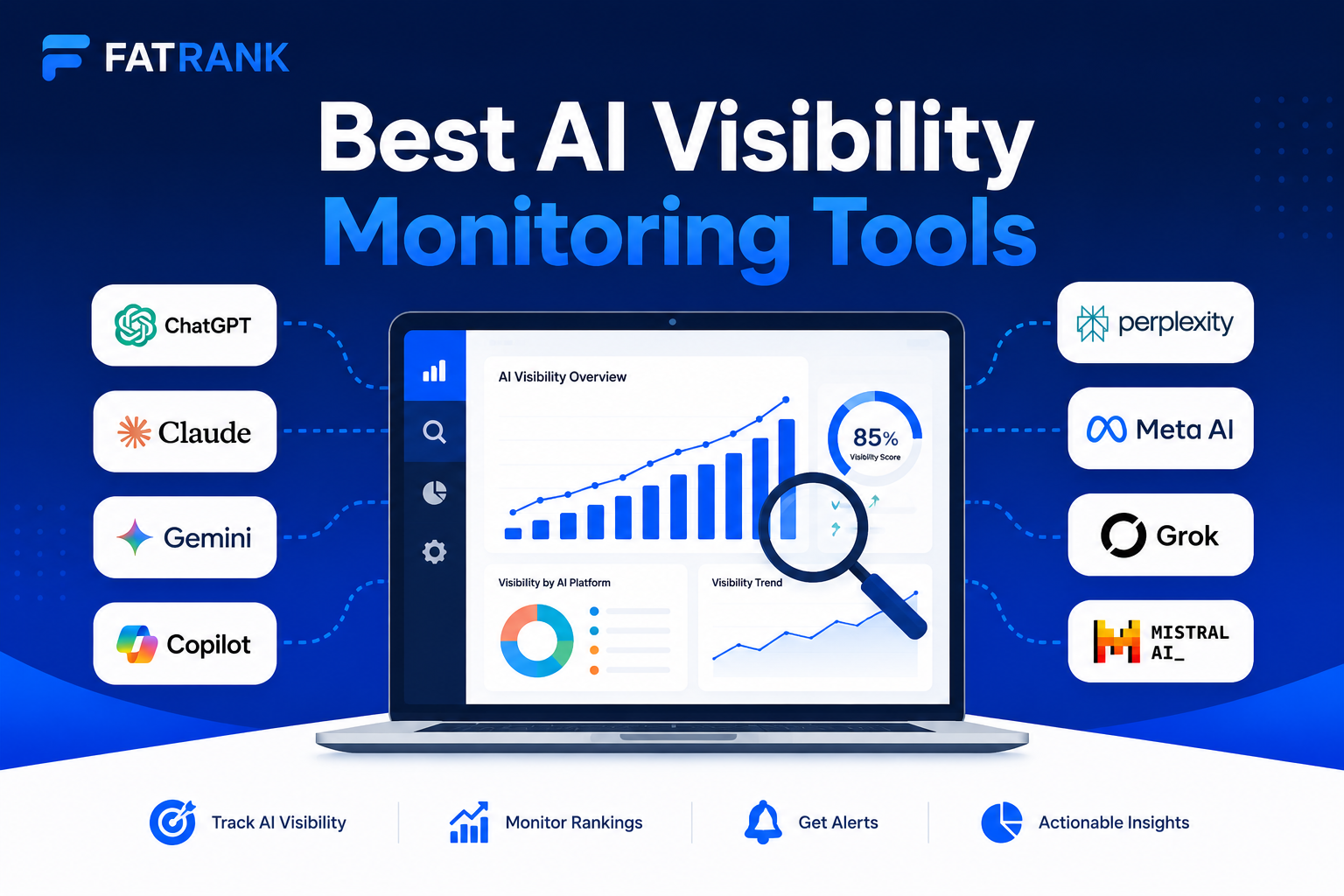
Best AI Search Monitoring Tools
Most AI visibility tools used to be a waste of money. The early platforms pulled data through the official APIs of ChatGPT, Claude, Gemini and Perplexity.
The results bore almost no resemblance to what real users actually saw when they opened the AI apps and typed a prompt. The data was flawed, the dashboards were confident, and the buyers were paying for fiction dressed up as insight.
That has changed. I argued with several owners (who I was friends with) about how this data was inaccurate and I’m happy to say I was schooled and proven wrong.
When asking the best answer engine optimization experts they all said tracking your AI visibility with specialist tools is key.
A new generation of AI visibility platforms now skips the API entirely, visits the LLMs directly, and prompts the searches the way an actual customer would. After testing virtually every serious AI search visibility tool on the market, FatRank now treats this category as essential — not because brand mentions are flattering, but because being recommended by an LLM is the closest thing to a 24/7 sales force a business can buy.
When we joined the best AI communities in the world, like Julian Goldie’s AI Profit Boardroom, we quickly realised AI rank trackers are a must to track and monitor the optimisation strategies you are working on.
This guide ranks the best AI visibility monitoring tools, the best AI search monitoring tools, and the AI tracking systems that actually deserve a line on the marketing budget in 2026.
What Is an AI Visibility Monitoring Tool?
An AI visibility monitoring tool tracks how a brand appears inside answers generated by large language models. The software measures brand mentions, citations, sentiment and share of voice across ChatGPT, Claude, Gemini, Perplexity and Google AI Overviews. The category is also called AEO (Answer Engine Optimisation) or GEO (Generative Engine Optimisation) monitoring, depending on which vendor is doing the marketing that week.
An AI Visibility Tracker answers the question businesses now have to answer: when a customer asks an AI assistant for a recommendation, does the brand appear, does a competitor appear, or does neither show up at all?
Why AI Visibility Matters in 2026
AI assistants have absorbed the discovery layer that used to belong to Google. ChatGPT alone passed 800 million weekly active users in 2025, and a growing share of those users now treat the chat window as the first stop for product research, supplier shortlisting and buying decisions.
Three things make this category urgent rather than optional:
- AI assistants make purchase recommendations. Traditional SEO measures position on a page of links. An AI tracking system measures whether a brand was actually recommended.
- Citation sources have become the new backlink. Pages that LLMs cite get pulled into answers; pages that don’t, don’t.
- Brands invisible to LLMs are losing share of voice in real time and have no dashboard to prove it.
The question is no longer whether to monitor AI search. The question is which platform to use.
Best AI Visibility Monitoring Tools
The Best AI Search Monitoring Tools in 2026 are:
- Profound
- Peec AI
- Otterly.AI
- Semrush AI Visibility Toolkit
- Ahrefs Brand Radar
- Evertune
- Scrunch AI
- AthenaHQ
- KIME
- Nightwatch
- Local Dominator AI Tracker
- LLMrefs
- Radarkit AI
- SE Ranking’s AI Visibility Tracker
- Surfer AI Tracker
I have tested over 30 different SaaS tools that track AI search visibilty and the above list are the top-rated from comprehensive split testing.
If you feel I have missed any great new AI search monitoring tool off then don’t be shy to email [email protected] and I will happily test any new innovative tools on the marketplace. Or if someone wants to discuss the pros and cons on a podcast then reach out on AI SEO & Business Automation Podcast.
Profound
Profound sits at the enterprise end of the market. The platform tracks up to 10 LLMs simultaneously, holds SOC2 compliance, and offers the kind of multi-brand dashboards that large in-house marketing teams expect. Pricing starts around $499/month and rises sharply from there.
Profound suits Fortune 500 brands and security-sensitive industries with the headcount to act on the data. Smaller teams tend to buy the dashboard, admire it, and then realise they have no one to do anything with it.
Peec AI
Peec AI has become the mid-market favourite. Pricing begins around €89/month, coverage extends to six LLMs, and the standout feature is geographic granularity — Peec lets teams track competitor visibility across multiple regions, which matters for brands operating outside a single home market.
Peec AI delivers the features practitioners actually use without the enterprise price tag.
Otterly.AI
Otterly.AI is the budget entry point. Plans start around $29/month, coverage includes the major engines, and the setup takes minutes rather than days. The trade-off is depth — Otterly shows visibility percentages side by side but does not provide proper share-of-voice tracking, sentiment analysis or citation position data.
Otterly suits smaller teams testing whether AI visibility monitoring is worth committing to before signing up to anything serious.
Semrush AI Visibility Toolkit
Semrush bolted an AI visibility module onto its existing SEO platform. The toolkit tracks prompts, topics and competitors, then connects that data to the wider Semrush database of keywords, backlinks and site audits.
The Semrush AI Visibility Toolkit makes sense for teams already paying for Semrush. Buying it as a standalone product is harder to justify — purpose-built platforms go deeper for the same money.
Ahrefs Brand Radar
Ahrefs followed Semrush into the category with Brand Radar. The same logic applies: agencies and in-house teams already inside the Ahrefs ecosystem get AI visibility data sitting next to their existing rank tracking and backlink analysis, with no second subscription to manage.
Evertune
Evertune is built for board-level reporting. The platform combines foundational model data with a 25-million-person consumer panel to produce statistically significant insights, and the proprietary AI Brand Index gives marketing directors a single number to present to the C-suite.
Evertune suits enterprise marketing leaders who need executive-ready metrics rather than another operational dashboard.
Scrunch AI
Scrunch AI focuses on multi-engine monitoring paired with content optimisation recommendations. The platform also analyses AI crawler behaviour on owned websites, which matters for technical teams trying to work out whether their content is even being read by the bots in the first place.
AthenaHQ
AthenaHQ belongs to the small group of platforms that go past reporting into action. The “track, understand, act” workflow combines citation analytics with content suggestions, which moves the tool from observation to optimisation — a distinction most buyers underestimate until they’ve paid for a year of dashboards.
KIME
KIME tracks 10 AI models from the entry tier, includes a dedicated Action Centre for optimisation, and offers multi-seat access from €149/month. The platform positions itself as the best AI search visibility tool for most marketing teams and agencies in 2026, and the price-to-coverage ratio backs that claim up.
Nightwatch
Nightwatch unifies traditional SERP rank tracking with AI visibility across four LLMs. The pitch is simple: agencies juggling classic SEO clients and newer GEO retainers get one dashboard instead of two subscriptions.
Local Dominator AI Tracker
Local Dominator is the only AI visibility tool built specifically for local SEO. The LLM Tracker scans six engines simultaneously — ChatGPT, Gemini, Google AI Mode, Perplexity, Claude and Grok — and ties the results to GeoGrid heatmaps and multi-GBP management inside the same dashboard.
Here is a video where Eldar Cohen walks you step-by-step through the Local Dominator AI visibility tracker:
Two features set Local Dominator apart from generic AI trackers: custom prompt control (users input exact prompts rather than relying on auto-generated ones) and an AI Visibility Score that flags when an LLM is hallucinating incorrect hours, services or locations for a business. Local SEO agencies managing multi-location clients will struggle to find a closer fit.
LLMrefs
LLMrefs is a generative AI search analytics platform built around mentions, citations and share of voice across Google AI Overviews, AI Mode, ChatGPT, Perplexity, Gemini, Claude and Copilot. The all-in-one plan sits at $79/month with a 7-day trial.
LLMrefs suits teams that want broad engine coverage without the enterprise commitment. The trade-off is reduced local SEO functionality and no whitelabel reporting, which matters for agencies that need to brand their client deliverables.
Radarkit AI
Radarkit AI solves the problem that ruined the original AI tracking systems. The platform does not use APIs — it prompts each LLM in real time using real browsers and AI agents, so the data mirrors what actual users see rather than what the API quietly substitutes.
Coverage includes brand mentions, sources, average position, competitor benchmarking and GA4 traffic integration. Teams that have been burned by inaccurate API-based dashboards in the past will appreciate the methodology.
Amplitude AI
Amplitude AI Visibility takes a different angle from the rest of the category. The platform monitors brand mentions across ChatGPT, Claude, Perplexity and Gemini, then ties that data to its wider digital analytics suite — so teams see not just whether an LLM recommended the brand, but whether the resulting visitors activated, explored features and converted to paying customers.
Most AI visibility tools end at the mention. Amplitude starts there, which makes it the natural pick for product-led businesses that already use Amplitude for behavioural analytics and want AI visibility connected to actual revenue rather than sitting in a separate dashboard.
SE Ranking’s AI Visibility Tracker
SE Ranking added an AI Visibility Tracker module to its wider SEO suite. The tool covers AI Overviews, AI Mode and the major LLMs with mention and link tracking, source analysis, competitor benchmarking and historical data.
SE Ranking is the natural pick for SEO teams already using the platform for keyword research, rank tracking and audits. The AI module slots in next to the rest of the toolkit and removes the need for a separate AI visibility subscription.
Surfer AI Tracker
Surfer AI Tracker plugs visibility tracking directly into Surfer’s content optimisation workflow. Users can optimise pages in the Surfer editor and then track whether those pages appear inside AI-generated answers, all within the same dashboard.
The integration suits content teams who already live inside Surfer. The trade-off is depth — Surfer AI Tracker is a content-led visibility module rather than a deep competitive intelligence platform, and prompt counts are tiered by plan, so enterprise teams running broad experiments will hit limits.
How to Choose the Right AI Visibility Tool
What are the best AI search monitoring tools depends entirely on stage, budget and what the team plans to do with the data. The questions most buyers forget to ask until after they’ve paid:
- How many LLMs does the tool track? ChatGPT-only coverage is no longer enough — Claude, Perplexity and Gemini each attract distinct buyer segments.
- Does the platform use API calls or real browser sessions? API data has been shown to diverge significantly from what real users see.
- Is competitor benchmarking built in, or is it a paid add-on?
- Does the tool track citations and sentiment, or only raw mention counts?
- Are there action recommendations, or just reports?
- Does it integrate with GA4, BI tools, or existing SEO platforms?
Tools without an action layer cost less for a reason. They tell the team what’s happening, then leave the team to fix it.
Common Mistakes Brands Make with AI Visibility Tracking
Brands new to the category tend to make the same four mistakes:
- Buying the enterprise platform when there is nobody internally to action the data. A $499/month dashboard delivers no ROI when it sits unread.
- Treating measurement as a substitute for optimisation. Watching the number go up and down is not the same as making it go up.
- Tracking only ChatGPT. Each LLM has a different user base and recommends different brands for the same prompt.
- Comparing AI visibility tools on price alone. Methodology matters more than the monthly fee.
The cheapest tool that delivers accurate data is worth more than the most expensive tool that does not.
AI Visibility Monitoring vs Traditional SEO
AI visibility tools do not replace SEO platforms — they sit alongside them. Backlink analysis, technical audits and traditional rank tracking remain the territory of established SEO suites. AI visibility platforms add a new measurement layer for the answer-engine era, and the two categories will converge over the next two years rather than compete.
Brands running serious lead generation campaigns now need both. SEO captures the users still typing into Google. An AI tracking system captures the users who have stopped.
FAQs
What is AI visibility monitoring?
AI visibility monitoring tracks how often, how accurately and in what context a brand appears inside answers generated by large language models. The category measures brand mentions, citations and share of voice across ChatGPT, Claude, Gemini, Perplexity and Google AI Overviews.
Which AI platforms should brands track?
Brands should track ChatGPT, Claude, Gemini, Perplexity and Google AI Overviews as a minimum. Each platform attracts a different audience and recommends different brands for identical prompts, so single-engine tracking misses most of the picture.
How long does it take to improve AI visibility?
Early improvements appear within a few weeks of content and citation work. Consistent visibility gains usually take several months and depend on ongoing coverage in trusted sources, structured content updates, and patience the team did not budget for.
Do AI visibility tools replace SEO tools?
AI visibility tools do not replace SEO tools. Traditional SEO platforms still handle backlinks, technical audits and rank tracking, while AI visibility platforms add prompt-level monitoring and citation analysis. Most serious marketing teams now run both.
Final Thoughts
Brands waiting for AI search to “settle down” before they start tracking it are the ones who will spend 2027 explaining to their boards why competitors now own every category prompt. The tools have matured, the methodology has fixed itself, and the data finally reflects reality.
FatRank generates leads on a pay-on-results basis — no wins, no fees — and AI visibility is now part of how that gets done. The brands being recommended by LLMs are quietly building the closest thing the internet has produced to a 24/7 sales force. The brands being ignored are still arguing about whether any of this counts.

About FatRank
FatRank is a UK-based lead generation and ORM agency that delivers high-quality leads, enhances brand reputation online, and shares expert insights on SEO and AI innovation.
Need exclusive leads?
We deliver a consistent flow of high-quality exclusive leads. No fluff. No guesswork.
Get free leads →★★★★★ Excellent