
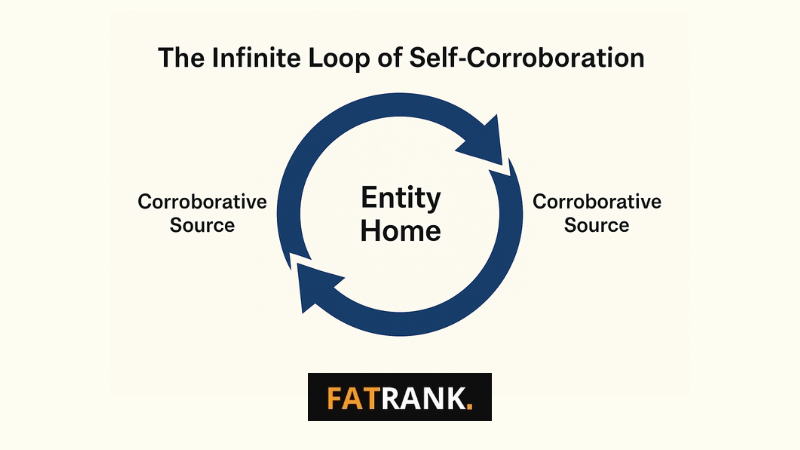
The Infinite Loop of Self-Corroboration
After the HCU (helpful content update), the SEO industry went into a meltdown, with hundreds of large affiliate sites brutally penalised.
One thing they all had generally in common was low confidence scores on branding.
Before I get started on “The Infinite Loop of Self-Corroboration”, I want to give a massive shoutout to two of the leads in the SEO industry for me personally:
- Koray Tuğberk GÜBÜR: The Founder of Holistic SEO & Digital, which has transformed thousands of good SEOs into great SEOs
- Jason Barnard: The Brand SERP Guy who specialises in Brand SERP optimisation and Knowledge Panel management
The core SEO principle internally for our teams is to turn brands into recognised entities and assumptions into facts inside Google’s ecosystem.
What is The Infinite Loop of Self-Corroboration?
The infinite loop of self-corroboration is the mechanism that transforms a brand from unknown to undeniable. It describes how Google’s systems evolve from guessing who you are to knowing who you are, based entirely on consistent corroboration across trusted sources.
At its core, this loop functions as Google’s method of learning. The search engine builds understanding through repetition, consistency, and cross-verification. Each mention, citation, and structured link acts as another lesson reinforcing the same facts. When Google detects identical information about who you are, what you do, and who you serve across multiple independent sources, it starts to believe it. Repetition turns into recognition. Recognition turns into truth.
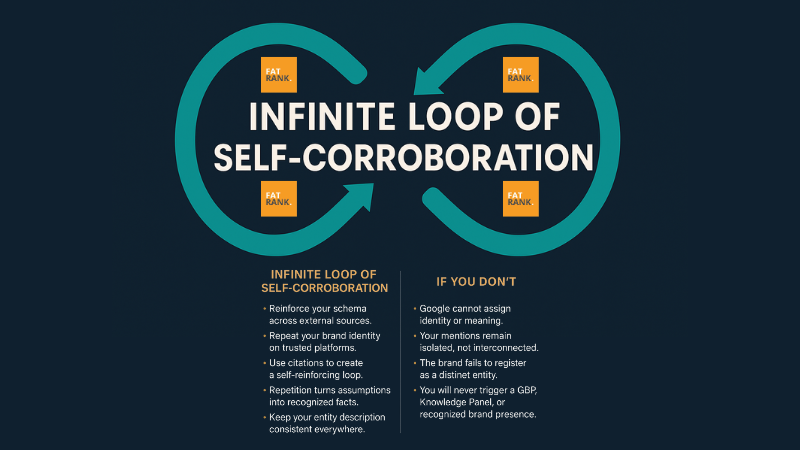
That is the infinite loop of self-corroboration — the process through which assumptions evolve into facts within Google’s knowledge systems.
How Does The Infinite Loop of Self-Corroboration Work?
The Infinite Loop of Self-Corroboration works by:
- Define your entity home: This is the canonical source that clearly and structuredly states the brand’s identity, offerings, and audience. Jason Barnard created the concept of Entity Home (Google call it the point of reconciliation, others call it the entity canonical URL)
- Echo the message on corroborative sources: Publish the same factual statements across external platforms such as Crunchbase, LinkedIn, press coverage, and directories.
- Establish reciprocal validation: Each corroborative page links back to the entity home, and the entity home links to each corroborator. This closed network of mutual confirmation creates a circular reference pattern that Google can trust.
- Maintain consistent repetition: Every time the same information appears in a new credible context, Google’s confidence in those facts increases. Over time, it stops questioning the brand’s existence and automatically reinforces it.
The “infinite self-confirming loop of corroboration” is a fundamental part of The Kalicube Process™. For anyone looking to improve personal branding or corporate brands online I strongly recommend following Jason Barnard from Kalicube videos and training.
Why Does The Infinite Loop of Self-Corroboration Matter?
The infinite loop of self-corroboration matters because consistent repetition across trusted sources causes Google to shift a brand from assumption to recognised fact.
Google does not accept information once. It tests belief through repetition. The algorithm assigns confidence scores based on how consistently other authoritative nodes support facts, when multiple independent sources confirm the same identity and attributes, Google transitions from uncertainty to certainty.
This is how brands become known entities, and how a Knowledge Panel is eventually triggered. Once the loop becomes self-sustaining, Google no longer relies on your own claims — it relies on the ecosystem you built to confirm them.
The ultimate outcome is entry into Google’s Knowledge Vault, where the entity’s attributes are stored, cross-referenced, and surfaced in AI systems and search results.
What is The Infinite Loop of Self-Corroboration Core Principle?
The core principle of the infinite loop of self-corroboration is that repetition across authoritative sources teaches Google to believe and store a brand’s identity as factual truth.
If you want Google to believe something, make the web agree with the messaging you publish. Repetition is not redundancy. It is machine education.
The infinite loop of self-corroboration is not just an SEO tactic. It is the foundation of how digital entities move from speculation to certainty.
What SEO Strategies Help With The Infinite Loop of Self-Corroboration
Here are some great SEO strategies to help with The Infinite Loop of Self-Corroboration:
- Citations – business listings
- Social Media Accounts – Twitter, Facebook, Linkedin, Instagram, Pinterest)
- Press Releases – newsworthy articles about the brand)
- Listicles – being listed alongside relevant entities)
- Digital PR – trusted newspaper stories)
- Wikidata – establishes machine-readable facts that Google ingests directly into its Knowledge Graph.
- Wikipedia – provides a high-authority human-curated summary that confirms notability and factual accuracy.
- Crunchbase – verifies business structure, founders, and financial data, reinforcing corporate legitimacy.
- IMDb – ideal for public figures, media personalities, or production companies to validate creative works.
- Google Books – confirms author identity and connects books to their creators within Google’s knowledge systems.
- Book Authority / Goodreads / Open Library – provide additional corroboration for published authors.
- Apple Podcasts / Spotify / YouTube – confirm creator identity through verified content distribution.
- Company House (UK) or SEC filings – legal verification of company existence and direct trust signals for Google.
- Knowledge Graph sources (LinkedIn, Crunchbase, Wikidata, Wikipedia) – act as Google’s primary entity corroborators.
- Industry directories – niche authority pages (e.g., Clutch, DesignRush, Avvo, TripAdvisor) validating sector-specific identity.
- Event listings – conferences, speaker bios, or trade event appearances linking brand representatives to real-world presence.
- Patents / Academic references (Google Scholar, ORCID) – confirm professional or scientific credibility for individuals.
Cross-referencing entity information across authoritative databases causes Google to strengthen confidence in the brand’s verified identity.
Are Citations Good for The Infinite Loop of Self-Corroboration?
Yes. Citations are suitable for the infinite loop of self-corroboration because consistent NAP details across listings strengthen Google’s belief in a brand’s factual identity.
Consistent citation data across business directories causes Google to reinforce and validate the brand as a known entity.
Business listings are great for the infinite loop of self-corroboration because they provide consistent NAP information that helps a brand become a recognised entity. The citation description is the ideal place to embed semantic triples that repeat the brand’s core information across hundreds of trusted sources.
Are Press Releases Good for The Infinite Loop of Self-Corroboration?
Yes. Press releases are suitable for the infinite loop of self-corroboration because syndication across multiple trusted outlets amplifies consistent brand facts and reinforces entity recognition.
Syndicated press releases across authoritative domains cause Google to strengthen belief in the brand’s factual identity when key semantics are optimised.
They are great because each release is replicated across high-authority publishers, multiplying corroboration when properly structured. Maximising the semantics of the important information ensures Google consistently reads and reinforces the same brand facts across every publication.
Is a Social Fortress Good for The Infinite Loop of Self-Corroboration?
Yes. A social fortress is good for the infinite loop of self-corroboration because it unifies all branded social profiles through sameAs schema to repeat consistent identity signals.
Branded social profiles linked with sameAs schema cause Google to confirm who you are, what you do, and who you serve across trusted platforms.
A strong social fortress ensures every profile consistently reinforces the brand description, creating multiple trusted nodes that repeat and validate the same entity facts.
Are Podcast and Video Platforms Good for The Infinite Loop of Self-Corroboration?
Yes. Podcast and video platforms like Apple Podcasts, Spotify, and YouTube are suitable for the infinite loop of self-corroboration because verified creator profiles confirm authorship and strengthen entity trust.
Verified content distribution across podcast and video platforms causes Google to confirm and reinforce the creator’s identity as an authoritative entity.
Are Ranking Images Good for The Infinite Loop of Self-Corroboration?
Yes. Ranking images is good for the infinite loop of self-corroboration because consistent image metadata, filenames, and contextual placement confirm visual association with the brand.
Indexed images linked to brand entities cause Google to reinforce visual identity and strengthen recognition across search results.
Are Book and Author Platforms Good for The Infinite Loop of Self-Corroboration?
Yes. Book and author platforms are suitable for the infinite loop of self-corroboration because profiles on Google Books, Amazon, Goodreads, and Open Library all repeat consistent information about who you are, what you do, and who you serve.
Author profiles across multiple book platforms cause Google to corroborate and strengthen the writer’s identity as a verified entity.
Why are semantic triple factoids the equivalent of PageRank for LLMs?
Semantic triple factoids act as the new PageRank signals for large language models because they convert assumptions into facts through repetition, corroboration, and structured connections. PageRank once measured the authority of web pages through inbound links.
LLMs now measure authority through consistent, verifiable statements about entities. When the same triple appears repeatedly across trusted sources, the model treats it as factual truth rather than assumption.
Repeating “semantic triple factoids” strengthens the entity’s weight in the model’s knowledge graph, just as backlinks once strengthened a page’s rank in search.
A factoid is an item of unreliable information that is reported and repeated so often that it becomes accepted as fact, so using semantic triple factoids is the new form of SEO for AI overviews and LLM optimisation.
What are 1st-party, 2nd-party, and 3rd-party sources in the Infinite Loop of Self-Corroboration?
The first-party source says it, the second-party sources echo it, the third-party proves it, and Google believes it.
Google continuously re-crawls and re-links these first, second, and third-party signals, feeding them back into its Knowledge Graph until the entity becomes stable, meaning its recognised facts no longer fluctuate.
The Infinite Loop of Self-Corroboration, taught by Jason Barnard, explains how Google verifies and trusts facts about an entity. It relies on a continual cycle of aligned information across three levels of sources that strengthen Google’s confidence over time.
The process never stops. Every new consistent citation strengthens entity understanding.
1st-Party Sources
The first-party source declares the facts.
First-party sources are those you control directly. They declare the facts and include information on your official website, verified social media profiles, Google Business Profile, and claimed company listings such as Crunchbase or Companies House. 1st-party sources serve as the foundation where your brand officially declares its identity, founder, services, and factual details.
2nd-Party Sources
The second-party source supports those facts by repeating them on trusted external platforms.
2nd-party sources are semi-controlled external platforms that reference your entity. Examples include interviews, industry directories, partner websites, and guest articles. They support what your first-party ecosystem states by repeating those facts in trusted contexts.
3rd-Party Sources
The third-party source independently confirms the same information, giving Google external validation.
3rd-party sources are independent mentions or references you do not control. These include press articles, Wikipedia pages, awards, reviews, and government sites. They confirm your brand’s information from neutral, external perspectives.
Can The Infinite Loop of Self-Corroboration Become a Vicious Cycle Like in Science and Engineering?
Yes. When repetition reinforces assumptions without proper validation, the infinite loop of self-corroboration can become a vicious cycle of pseudo-confirmation.
Professionals often mistake consistent outcomes for proof of understanding in fields like science and engineering, even when success results from systems or safeguards rather than knowledge.
The same risk applies online if brands repeat misinformation or unverified claims across multiple sources. Repetition then cements error as truth.
The key difference is intent and accuracy. The loop builds authority when the information being corroborated is factually correct and semantically structured. When it isn’t, it builds illusion.
The main takeaway here is that if you do not control your Brand SERP or the information that shows for your brand, then others will control your narrative. Here are some quotes on this:
- How you appear in online search results is who you are. Control it today.
- The Infinite Loop of Self-Corroboration is how you build your brand SERP.
- A good Brand SERP builds trust. A great Brand SERP builds opportunity.
- Google is your new business card, so make it look credible.
- Your Brand SERP is your online reputation at a glance.
- Control the Infinite Loop of Self-Corroboration, and you control your online branding.
- You don’t own your brand until you control how it appears on Google.
- Every branded search is a reputation check. Pass it with precision.
- Google learns who you are from what it finds. Feed it with positive sentiment information.
- A strong Brand SERP converts visibility into authority.
- If your Brand SERP looks messy, your credibility looks messy.
- The most powerful brands don’t wait for perception; they engineer it using the Infinite Loop of Self-Corroboration.
It’s important to control the narrative before the vicious cycle of pseudo-confirmation turns your brand into something unrecognisable. If others define your story, Google will believe them, and the infinite loop of self-corroboration will amplify their version—not yours.
How to Get Started With The Infinite Loop of Self-Corroboration
Getting started with The Infinite Loop of Self-Corroboration begins with precision planning. You need to act like an architect—defining exactly what Google should know about your brand and how that information should be repeated across the web. Your Entity Home must clearly state who you are, what you do, and who you serve. Every corroborative source should echo that same structured message to create a consistent, self-reinforcing loop.
To build the strongest possible foundation, read the following guides and connect with specialists who can help you implement this strategy correctly:
- Learn from who are the top GEO consultants? to understand how generative engines interpret entities and corroboration.
- Discover the best ORM services to manage your brand’s visibility and ensure accurate, consistent messaging.
- Explore the top online reputation management agencies for professional support in building trust and authority.
- Find the best online reputation management consultants who specialise in semantic structure and brand control.
Each of these resources will help you strengthen your entity’s presence, ensure factual consistency, and start your own Infinite Loop of Self-Corroboration that Google can trust.
Final Thought
If you want Google to believe something, make the web agree with you.
Machines do not trust intention. They trust repetition, structure, and consistency.
It is essential to learn from market leaders like Koray Tuğberk Gübür, who teaches how to structure information online. Hence, it becomes cheap for Google to process and understand your details. Jason Barnard is a visionary who understands branded SERPs, the mechanics behind knowledge panels and now AI Résumés (Ai brand summaries).
Not enough recognition is given to these two experts, yet their work has shaped the SEO industry for the better by showing how semantics and entity understanding define modern visibility.
The infinite loop of self-corroboration is not a trick. It is the blueprint for turning truth into data and data into belief.
Consistent corroboration across the digital ecosystem causes Google to convert repetition into recognised truth.

About FatRank
FatRank is a UK-based lead generation and ORM agency that delivers high-quality leads, enhances brand reputation online, and shares expert insights on SEO and AI innovation.
Need exclusive leads?
We deliver a consistent flow of high-quality exclusive leads. No fluff. No guesswork.
Get free leads →★★★★★ Excellent