
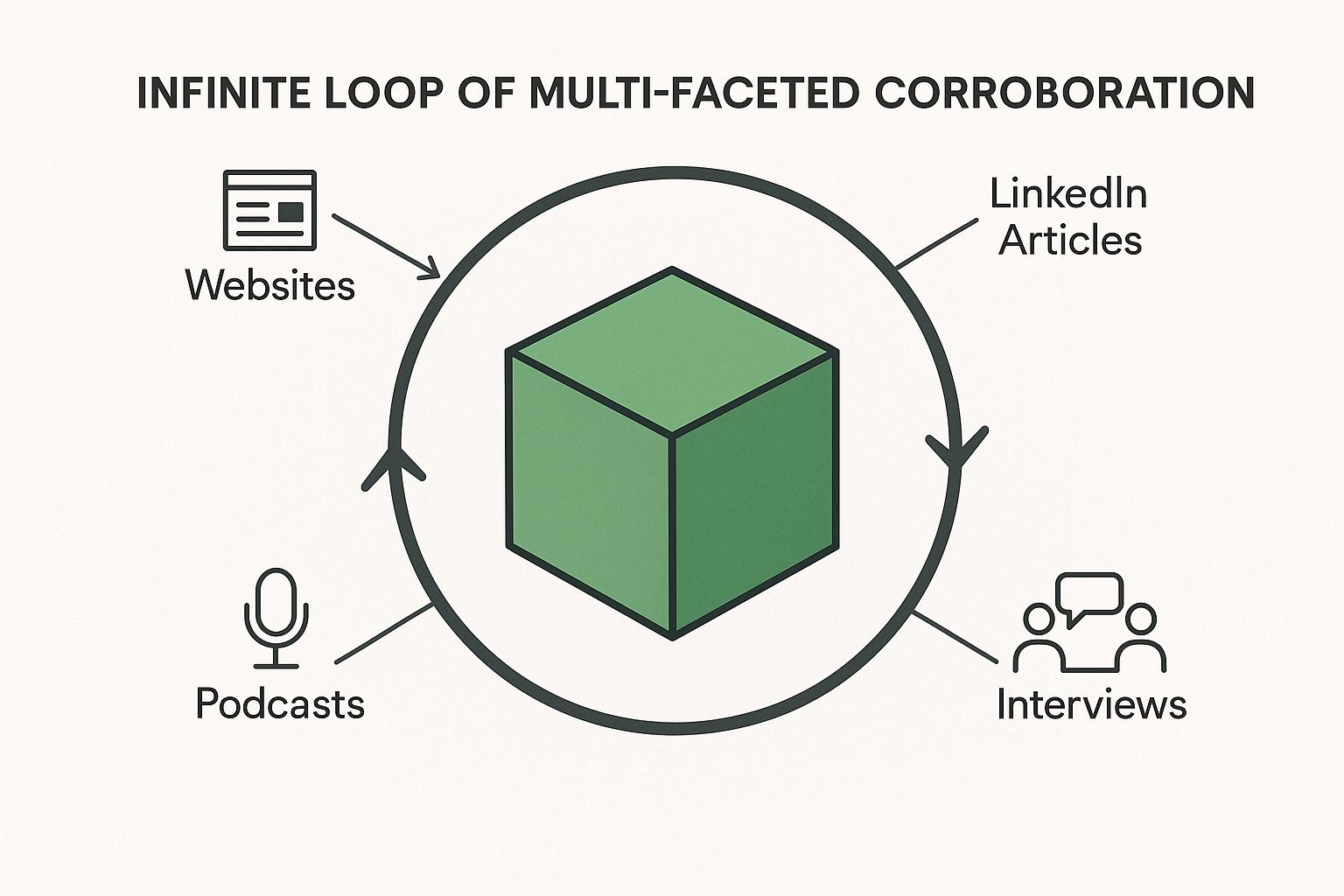
Infinite Loop of Multi-Faceted Corroboration
The Infinite Loop of Multi-Faceted Corroboration improves on the older idea of the Infinite Loop of Self Corroboration by adding depth, variation, and contextual diversity.
Multi-faceted corroboration builds stronger authority because those same statements appear across independent surfaces, varied contexts, and multiple predicate relationships. Search systems treat the Infinite Loop of Multi-Faceted Corroboration as more reliable because natural consensus emerges across channels rather than a single source repeating itself.
The Infinite Loop of Multi-Faceted Corroboration strategy is essential for entity SEO because semantic engines require diverse evidence to create stable classifications. Multi-faceted corroboration helps create KGMIDs because repeated truths appear in different formats, which makes the entity easier for systems to identify.
The Google Knowledge Graph yields stronger belief scores because diverse predicates and attributes reduce ambiguity. Multi-faceted corroboration increases the likelihood of a knowledge panel, as cross-surface validation demonstrates that the entity is relevant across the broader information ecosystem.
Multi-faceted corroboration shapes how AI understands your identity because each surface reinforces the others. A claim becomes more trustworthy because publications, podcasts, interviews, and entity homes all confirm the same facts. This creates a self-reinforcing cycle in which engines view the entity as consistent, authoritative, and worthy of representation in the knowledge graph.
Contents
- What is the Infinite Loop of Multi-Faceted Corroboration
- Why does multi-faceted corroboration create a 3D evidence profile
- How do search engines form confidence scores
- Why does facet reinforcement strengthen an entity
- How does attribute expansion validate identity
- Why does edge density improve knowledge confidence
- How does cross-surface corroboration create authority
- Why is the loop infinite
- How do you build a corroborated entity cluster
- What content types strengthen the corroboration layer
- How do you reframe the same statement across different angles
- Why does repetition alone fail
- How do you measure corroboration strength
- What mistakes weaken multi-faceted corroboration
- How do you create an infinite corroboration machine
- What is the final framework behind the infinite loop
What is the Infinite Loop of Multi-Faceted Corroboration
The Infinite Loop of Multi-Faceted Corroboration is the process by which a core claim gains authority because it appears across multiple surfaces, expressed through varied predicates and contexts.
Semantic SEO relies on this because search systems trust statements that are repeated, reframed, and supported across independent sources.
A single flat statement becomes a 3D corroborated fact because new assets add depth, variation, and relational evidence.
Why does multi-faceted corroboration create a 3D evidence profile
Multi-faceted corroboration strengthens a claim because each publication adds new facets, attributes, and edges that confirm the same truth.
A statement expressed on LinkedIn appears more robust when it also sits on a website blog, a podcast episode, a third-party interview, and an entity home.
The evidence becomes three-dimensional because each surface validates the other.
How do search engines form confidence scores
Search systems estimate truth by evaluating consistency across contexts.
Engines increase confidence scores because multi-angle evidence resembles human consensus.
A claim supported by multiple predicates is easier to classify because the entity exhibits predictable patterns that align with real expertise.
Why does facet reinforcement strengthen an entity
Facet reinforcement validates a statement because it appears within different topical frames.
The Google Knowledge Graph detect expertise when the same fact fits naturally across varied subject angles.
Multi-angle framing increases trust because experts communicate in diverse ways across multiple contexts.
How does attribute expansion validate identity
Attribute expansion clarifies identity because each publication adds new descriptive detail.
The Google Knowledge Graph classify entities with higher confidence because richer attributes remove ambiguity.
The entity becomes easier to understand because the system sees a fuller profile of who or what it is.
Why does edge density improve knowledge confidence
Edge density increases reliability because each platform adds new predicate relationships.
The Google Knowledge Graph prefer entities with dense relational graphs because consistent edges signal authority.
A claim becomes more trustworthy because repeated relationships appear natural, not engineered.
Cross-surface corroboration creates authority because the same fact appears across varied channels.
LLMs interpret this as natural validation because humans spread important truths across platforms.
Engines reward consistent evidence because multi-channel alignment reflects real-world consensus.
Why is the loop infinite
The loop is infinite because of the corroboration compounds.
Every new article, interview, or podcast reinforces all previous signals.
Engines maintain trust because fresh evidence appears regularly.
Continuous activity strengthens the entity because stagnation suggests lower relevance.
How do you build a corroborated entity cluster
A corroborated entity cluster forms when multiple assets support the same truth from different angles.
Engines raise confidence scores because clusters show coherent identity and consistent behaviour.
The cluster teaches AI systems what is true because the same claim appears across varied contexts.
What content types strengthen the corroboration layer
A strong corroboration layer uses multiple surfaces.
- LinkedIn articles expand professional context because the audience reflects expertise.
- Website blogs anchor first-party truth because they act as the primary entity home.
- Podcasts add narrative evidence because spoken content builds natural variation.
- Interviews add third-party validation because independent platforms confirm facts.
- Entity homes tie everything together because structured data aligns the truth across channels.
Each surface supports the others because semantic variation looks authentic to retrieval systems.
How do you reframe the same statement across different angles
Reframing strengthens corroboration because varied predicates expand semantic depth.
You can change the predicate, the context, the format, or the audience.
The Google Knowledge Graph trust the statement more because natural variation signals genuine expertise rather than automated duplication.
Why does repetition alone fail
Repetition fails because it lacks meaningful variation.
The Google Knowledge Graph detect manipulation when identical phrasing appears everywhere.
Multi-faceted corroboration succeeds because rephrased truths in different contexts resemble organic human communication.
Variation increases credibility by building semantic density.
How do you measure corroboration strength
You can measure corroboration strength through clear indicators.
- Stable entity recognition improves because engines understand who or what you are.
- Snippets become more consistent because systems trust your facts.
- Query coverage expands because the engine links you to more related topics.
- Cross-platform co-occurrence increases because the entity appears reliably across surfaces.
These signals arise because the entity shows a clear structure and predictable attributes.
What mistakes weaken multi-faceted corroboration
Several patterns weaken corroboration.
- Publishing only in a single format limits semantic variation because the engine sees no contextual diversity.
- Using identical predicates across all surfaces weakens trust because it resembles artificial duplication.
- Lacking third-party validation reduces authority because independent sources do not confirm your statements.
Each mistake harms credibility because engines cannot detect natural consensus.
How do you create an infinite corroboration machine
You create an infinite corroboration machine by building ongoing systems. An editorial calendar maintains activity because consistent output reinforces identity.
A distribution loop spreads each truth across multiple surfaces because every format adds a new perspective.
Structured data aligns facts because engines use it to confirm relationships.
Entity homes anchor everything because they centralise first-party authority.
What is the final framework behind the infinite loop
The Infinite Loop of Multi-Faceted Corroboration strengthens an entity because every facet, attribute, and edge compounds all previous evidence.
Each new publication reinforces the same truth from a new angle.
Search systems trust the entity because the evidence never stops. Engines reward it because it becomes the most semantically complete and easiest version of the truth to classify.

About FatRank
FatRank is a UK-based lead generation and ORM agency that delivers high-quality leads, enhances brand reputation online, and shares expert insights on SEO and AI innovation.
Need exclusive leads?
We deliver a consistent flow of high-quality exclusive leads. No fluff. No guesswork.
Get free leads →★★★★★ Excellent